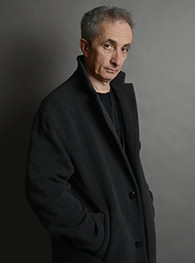
Le Pr Stéphane Velut est un neurochirurgien qui est aussi écrivain.
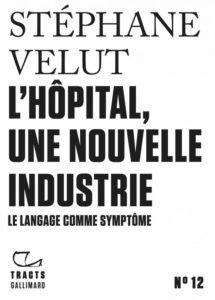
Il a écrit des romans, et récemment, dans la collection Tracts Gallimard, un livre consacré aux raisons du malaise dans l’hôpital public, et intitulé « L’hôpital, une nouvelle industrie ».
Il a été interviewé par le Monde qui lui a consacré un article 21 mars dernier.
L’article étant payant, je vous le copie ci-dessous.
At Tours hospital, "the staff, I don't manage it, I clean it"
Chronic
In his column, Frédéric Potet, journalist at the "World", recounts his meeting with Stéphane Vélut, head of the neurosurgery department of the CHU de Tours, who published in January, before the arrival of the Covid-19 epidemic in France, "the hospital, a new industry".
Chronique. Les praticiens et les personnels de santé l’ont dit et répété : le coronavirus n’arrive pas au meilleur moment pour l’hôpital, fragilisé par des réductions d’effectifs et des baisses de moyens. L’état de surchauffe permanent des équipes et les difficultés matérielles chroniques des services témoignent d’une dégradation des conditions de travail, dénoncée depuis longtemps à l’intérieur même des établissements. Il n’est pas inutile, dans ce contexte – le confinement invitant à ouvrir des livres –, de parcourir un petit ouvrage instructif sur l’origine du mal-être hospitalier, sorti mi-janvier : L’Hôpital, une nouvelle industrie, de Stéphane Velut, édité par Gallimard dans sa collection d’essais courts (48 pages) à petit prix (3,90 euros), « Tracts ».
The professor saw, 63, heads the neurosurgery service of the CHU de Tours. A novelist in his spare time, he published two works, Cadence (Christian Bourgois, 2009) and Festival (Verticals, 2014). It was his passion for words that led him to write this small subtitled text "language as a symptom". The doctor develops an unprecedented remarks aimed at describing how the language of the spheres of communication and the economy contaminated the hospital sector in order to make the non -capable of the nursing body accept: the reduction of expenditure.
What he describes as a "consent factory" jumped in Stéphane's eyes saw about two years ago, during a meeting at the CHU, in which the young employee of a consulting firm participated with a storefront. During the discussion, the latter addressed to the professor the following remark: “While remaining in an approach of excellence, it is now [necessary] to transform the stock hospital into a flow hospital. To say more prosaically things: patients remain for too long in the beds of his service; It would be good to accelerate the flow, circulation, movement - the "flow", in a word.
"Business Model", "innovative process" ...
The AS of the scalpel remained on it, amazed that we can speak of patients as vulgar sheets, of the type of those who cover the beds in question. “I lived so far in a happy blindness. This intervention awakened me politically within my own environment, ”said Stéphane saw in a cafe in downtown Tours, a week ago, just before the establishment of containment measures.
Written with an elegant pen, its essay is marked out of these terms which today invade the daily life of practitioners, in particular team managers: "new governance", "mutualisation", "problematic", "managerial organization", "business model", "innovative process", "optimization of practices" ... The author evokes these graphs, algorithms, Excel, who pollute the practice of specialists whom he prefers to compare to "craftsmen". The sacrosanct "management"-stocks like humans-does not stop parasitizing "esteem towards the flair, the eye and the hand", underlines the surgeon.
In thirty-eight years of career, Stéphane Velut has also seen the birth of new names in the organizational charts of the public hospital: "Deputy director", "Pole director", "Administration attaché", "senior manager" ... without forgetting the formidable "Bed Manager", responsible for supervising the flow flows, in other words the flow of patients. In some establishments, these different professions can reach two thirds of the medical staff, including internal, do not forget to recall the doctor.
Inversion of the primacy of speech
"The administrative body has regained control over the empathetic body [the caregivers]," he concludes, by deciphering a strategy developed using an opaque metalanguage, obese of clichés, and familiar with com teams and other consulting specialists. “All of this is the same intention: replacing the simple words with“ elements of language ”that adorn, reassure or the parent of abstraction for the purpose of intimidating. Orne, reassure, intimidate… makes consent, ”asserts Stéphane Velut.
In addition to the objective (the decline in means), what consequences are resulting in concretely from this policy, in a service like its own?, Is it asked that day, in front of a last espresso for a long time. "The only haven of peace I have is the operating room," he replies. Practitioners are currently in a greater stressful state when they open their mailbox than when they operate. "Do not use the term honored" management "in front of Stéphane Velut:" The staff, I do not manage it, I clean it, "he will formulate.
The COVVI-19 has at least one "advantage", in his eyes: decision-makers-politicians first-have no other possibility, from now on, than to hear, in turn, the language of doctors. Because they are "in contact with illness and death", they are used to using "concrete words to say what they do. They have no choice ”. This inversion of the primacy of speech, made necessary by the severity of the situation, will make it possible to unlock exceptional funds to fight the virus. "Whatever it costs," said Emmanuel Macron, on the evening of March 12.
That morning, Stéphane Velut grimacted by opening an internal letter from the CHU management. The fold contained a "methodological guide" inviting him to prepare for the individual individual interview (EAI) that he will have to pass, for the first time, to the seven practitioners of his service. Registered with the Ma Santé 2022 project, aimed at "renewal of hospital human resources management and professional recognition", these interviews can "reasonably last between one and two hours per practitioner received", it is specified. The surgeon sighs in advance: "We will do this as for our end -of -day meetings: in front of a fruit juice and cashew nuts. »»
https://www.lemonde.fr/idees/article/2020/03/21/al-hopital-le-personnel-je-ne-le-Marie-pas-ja- Le-menage_6033929_3232.html? FBCLID = iWar0TQDGTN0WPOZUM3SAL8RBKDNRUM08HOGBQMEZ2GHVWDDEQSL77VSTWY
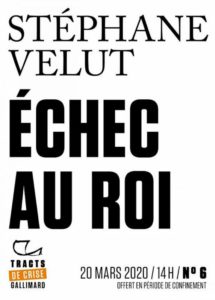
Parmi ses écrits, le dernier en date est téléchargeable gratuitement ici : https://tracts.gallimard.fr/fr/products/tracts-de-crise-n-06-echec-au-roi?fbclid=IwAR2Mhh_8sAQOK-mhOXI-9QHDzwc1patNw4RmNBNHk3BMZKgQOF6Iy7fwy00
Find other articles from Amavea here