Amavea and Anosmia
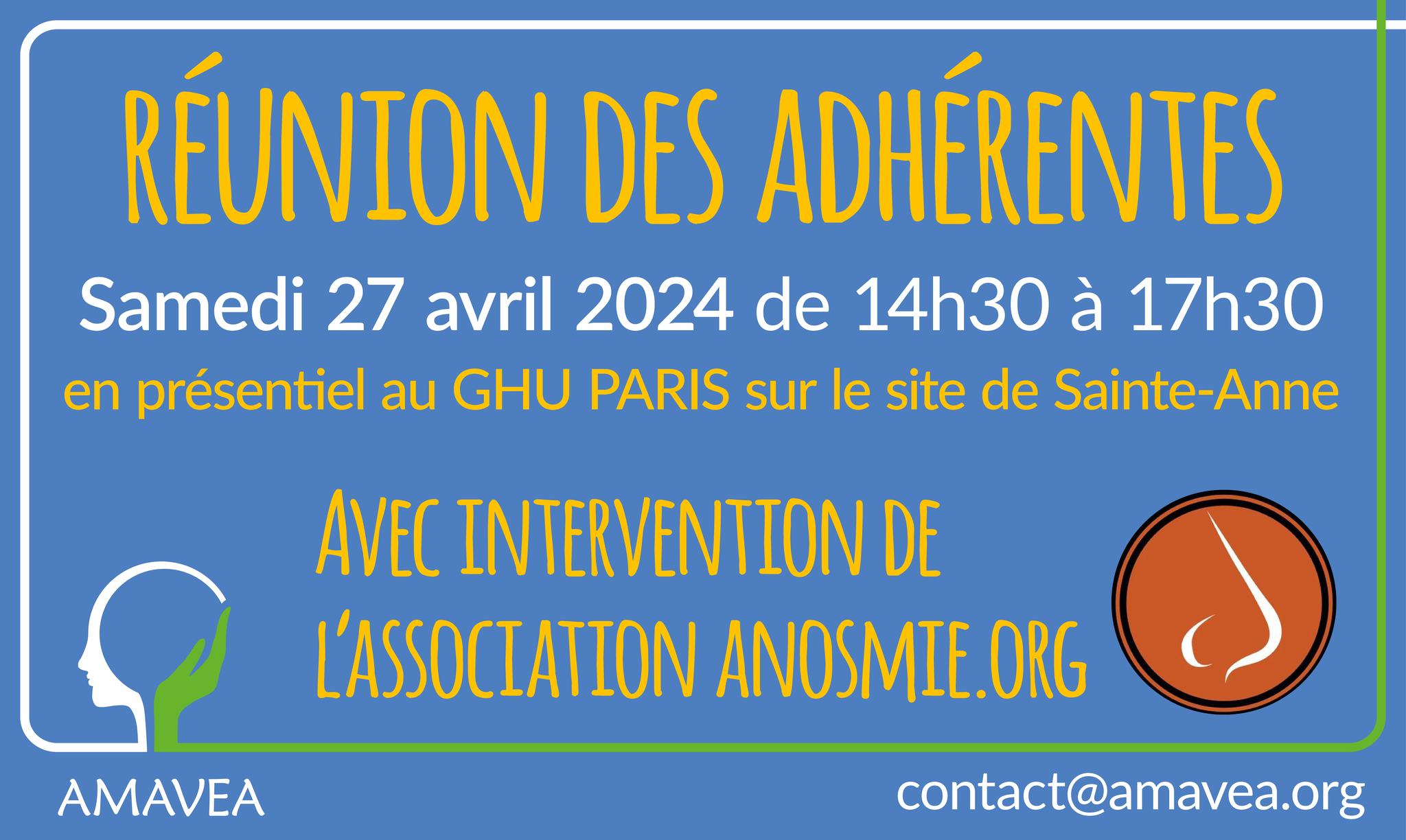
Conference of April 27, 2024
- Jean-Michel Maillard, founding president Anosmie
- Claire Martin, Olfaction research manager, CNRS Paris
- Magali Guibert, Ile de France regional delegate, Amavea
- Amavea and anosmia members
While we are surrounded by smells permanently, we hardly pay attention. Except when the scent of the scent of our bus neighbor reaches us or the compost bin is full.
By the sensors of the language, we identify the flavors of the food we eat, it is the taste.
Through inspiration, the fragrant molecules enter to the bottom of the nose, the odors, the aromas, it is smell.
Smelling and taste are often associated because very close and complementary, these are two different senses. If the smell is affected, the taste can be too, it is not systematic.
The smell is made up of several mechanical and neural elements that complement each other to send information to the brain.
The detection of smells (eg clementine, pink, cloves) is done in the nose by the olfactory mucosa (in orange on the drawing below). The information then went back to the brain by a structure called 'Olfactory bulb' (in yellow on the drawing below). This detection can be done by 2 different ways:
-
-
- The Rétronasal Way = air circulation from the back of the palate towards the nose inside the mouth
- The orthonasal route = air circulation directly through the nose
-
Source: anosmie.org
Definition of smell disorders
- Anosmia: Decrease or complete loss of smell.
- Hyposmia: decrease in olfactory capacities
- Parosmia: false sensation, leading to a distortion: from one taste to another taste; of one odor to another smell, generally unpleasant
- Phantosmia or ghostly: perception of an odor without physical presence causing it (olfactory hallucination)
L’anosmie concerne 5% de la population mondiale. Elle peut être congénitale ou avoir diverses causes :
- ENT diseases, polyps
- Virus like covid or flu
- Drugs, drugs
- Polluting
- Head trauma
- Tumor, neurological disease, surgery
- Age (Parkinson, Alzheimer's)
La présence d’une tumeur intracrânienne comme un méningiome près du nerf ou du bulbe olfactif peut entraîner un dérèglement olfactif et permettre de la déceler. La phantosmie est souvent un signe annonciateur de migraine, et peut être révélateur d’une tumeur fronto-temporale. Une IRM permettra d’établir le diagnostic.
- During an operation or radiotherapy to treat meningioma, the olfactory system may be damaged. Sometimes irreversibly if the nerve and/or the bulb are affected.
- Par contre, la muqueuse olfactive peut repousser et les neurones être rééduqués (exemple).
- Il existe peu de moyens de tester l’odorat. Sur cette page du site Anosmie.org des tests très simples sont proposés.
- To go further, it is recommended to consult an ENT in a specialized center (contact anosmie.org to have addresses in your region).
Les troubles de l’odorat ont une influence sur la mémoire et les émotions. Ils peuvent aussi entraîner une boulimie ou anémie (sensation de faim ou non), une dépression.
However, anosmia is never the first problem. The handicap never settles in a single time. We understand the impact several months later on
- The odors of everyday life: morning coffee, garden pink, scent of deo, ...
- Emotions: well-being, sensuality, disgust, comfort, vitality, nostalgia
- Danger: gas (detector), spoiled food.
- The taste is changed, loss of the pleasure of eating, adding sugar or salt to find sensations. On this subject, the third element of the olfacto-gustatory system is the trijumeau nerve which allows you to find the feelings of cold (mint), spice (pepper or sparkling bubbles), crunchy (hazelnut), ...
- Being, exist: laundry, our bodily smells
- Access certain memories, more difficult to find
- Family and relatives: children's smells.
L’anosmie entre dans le barème du handicap. Elle est reconnue par la MDPH et au niveau européen.
Lorsque l’on perd un sens ou une faculté, le plus difficile est de l’accepter.
Jean-Michel Maillard says that you have to "put your energy in a new life rather than try to recover the loss".
- It is important to share your suffering. Support does not always come from relatives, contact trained interlocutors: ENT, dietitian, psychologist.
- With acceptance, we find new benchmarks, we keep self -confidence, we create new rituals, we find ourselves a "nose" to help us when it is essential, we can try rehabilitation and share it with family.
Chaque cas de méningiome et de troubles de l’odorat est particulier. Nous vous invitons donc à vous rapprocher de l’association Anosmie.org pour toutes vos questions sur ce sujet.
Anosmie.org : association créée en 2017 par Jean-Michel Maillard. Animée par des bénévoles uniquement, référents scientifiques du CNRS, référents médicaux et paramédicaux, et des ambassadeurs en région. Journée mondiale de l’anosmie le 27 février.
Amavea.org : association créée en 2019 par Emmanuelle Huet-Mignaton. Animée par des bénévoles uniquement, un conseil scientifique de 3 neurochirurgiens et 1 radiothérapeute, des délégations régionales. Journée internationale de la sensibilisation aux tumeurs cérébrales le 8 juin.
Magali Guibert
Déléguée régionale Ile de France
Vidéo conçue par une chercheuse du CNRS et deux orthophonistes, explique le fonctionnement de l’odorat et l’impact délétère de son dysfonctionnement sur la qualité de vie. Elle vise à informer le grand public et les professionnels de santé sur le rôle de l’orthophoniste, qui sur prescription médicale, peut accompagner les patients dysosmiques dans la rééducation de leur odorat.
https://www.youtube.com/watch?v=4rgRVVOBy9s