TEXTE écrit en juin 2019,qui est toujours d’actualité.
Merci à Martin Winckler de l’avoir hébergé sur son blog : ecoledessoignants.blogspot.com/
Meningiomas caused by Androcur: a patient tells and creates an association
Comme la plupart des femmes, vous ne savez pas ce qu’est un méningiome.
Jusqu’en août 2017, je ne le savais pas non plus.
Like most women, you take the contraceptive pill, or a medication that reduces gynecological concerns, such as polycystic ovaries, excessive bleeding, which is also effective against acne or hirsutism.
Et on ne vous a jamais parlé de méningiome, une tumeur cérébrale, le plus souvent bénigne, et à croissance lente.
Et on ne vous a pas dit que certains médicaments n’ont jamais été testé par le laboratoire pharmaceutique qui le commercialise pour les pathologies pour lesquelles vous prenez ces médicaments.
On ne m’en avait jamais parlé non plus. Jamais.
Qui se moque de la santé des femmes ?
Qui pense que des effets indésirables gravissimes ne doivent pas être dit aux femmes, pauvres créatures sans cervelles (mais il est vrai que des tumeurs au cerveau améliorent grandement nos capacités de réflexion !) ? Des médecins, des gynécologues surtout, qui connaissaient le risque, mais qui se disaient que ça devait être si rare que ça ne valait pas la peine de le dire.
To tell you a little about my story, not the most terrible, but typical of what many women have experienced, and which has its share of sufferings which could have been avoided:
For years, I found myself slowed down, different. My body had changed, and my personality too. I have dragged bizarre symptoms, which have worsened over the years, for at least 8 years. I did not know that my cranial box housed 5 meningiomas, the biggest of which, like an orange to discover it, could have killed me. Do you image have something of the size of an orange in the head? And other smaller fruits: plum, cherries ...
I am one of the hundreds of people who, in France, were operated on with a meningioma and had taken Androcur for more than 5 years. A study by the CNAM released in 2018 has shown an over-risk to develop a meningioma when you take this medication for more than 6 months. And a very important risk when taking it over 5 years.
When I was received in September 2017 by the neurosurgeon who was going to operate me (yes, such a large meningiomal cannot regress enough to stop treatment, and it is too big for radiotherapy alone), he told me that my tumors were due to the medication; I didn't believe it.
I didn't believe it! How have 3 successive gynecology teachers have renewed, can they induce these kinds of consequences without my warning? Without anything, never, making me think that all my bizarre symptoms were due to this treatment?
It was unthinkable for me to have never been notified, or by associations I adored for endometriosis, or by any doctor. A non-fatal disease was treated by potentially fatal drugs, how was it possible? All drugs include risks, but those who take the contraceptive pill know them and they are mainly phlebitis or cardiovascular problems.
This medication stole me 10 years of my life, and rots me by its consequences on the days I have left.
Ma colère est immense face au silence de ceux qui savaient et qui n’ont rien dit.
Je souhaite à tous ceux qui se sont tus, par bêtise, par souci de carrière, que sais-je, de vivre une opération du cerveau. Et d’ensuite me dire s’il était normal de se taire.
I would have liked not to have to undergo so much. Like the violence of the sentence of a gynecology teacher who told me, when I told him that I was very angry at not having been warned of this possible devastating adverse effect: "A drug is a benefit-risk. When you take your car, you have a risk of dying and yet you take it anyway. A drug is the same ”.
The major difference, I told him, is that I know when I take my car that I can die. There, no one told me anything.
Et sa phrase finale : « J’espère que vous allez vous en sortir ».
Parce que parfois on ne s’en sort pas.
The aim of the association I created in January 2019, AMAVEA, association of victims of meningiomas due to drugs, is not to panic women, or to tell them that progestins are to be banned. No. Of course not. These drugs provide great services, for endometriosis for example, where it does not heal, but it allows you to live better.
But the information, what a hell! Inform and not infantilize women by hiding the truth from them. And the truth is simple: these treatments can induce brain tumors, certainly benign according to medical terminology, because not cancerous. But is everything that is non-cancerous is nevertheless benign? Is it benign to have his head opened? Is it benign to have lifetime consequences that prevent working? It is benign to be able to become the shadow of what we were, and to the extreme, to die?
Je ne le crois pas. Il faut être informée pour être en alerte si des signes neurologiques apparaissent.
Et les autorités de santé sont déjà en alerte pour l’Androcur (acétate de cyprotérone), puisqu’il ne sera plus possible à un médecin de le prescrire sans faire signer à la patiente une attestation d’information, qu’elle devra apporter à la pharmacie pour avoir la délivrance du médicament.
Et avant toute prescription, une IRM cérébrale sera nécessaire.
Reste à faire pareil pour le Lutéran et le Lutényl, et possiblement pour d’autres progestatifs, si cela s’avère nécessaire.
L’ANSM va enclencher une grande étude comme ça a été fait pour l’Androcur, mais des études ponctuelles montrent déjà que ces autres médicaments induisent parfois des méningiomes. Reste à savoir dans quelles proportions.
Thank you to Martin Winckler for giving me the opportunity to explain and talk about the association created, with the same objective as Marine Martin, president of the APESAC association, on the problem of antiepileptic drugs, the best known of which is Dépakine: shed light on all the dysfunctions of our health and pharmacovigilance system. And in parallel, have an association to request compensation for the damage suffered.
Thank you to the neurosurgeon, Professor Johan Pallud, who allowed me, in every sense of the word, for "rebuilding me".
Je ne suis pas une lanceuse d’alerte. Il n’y en a pas dans ce dossier, et les mots sont importants, car les journalistes mettent ce terme sur n’importe quelle personne qui s’insurge un peu.
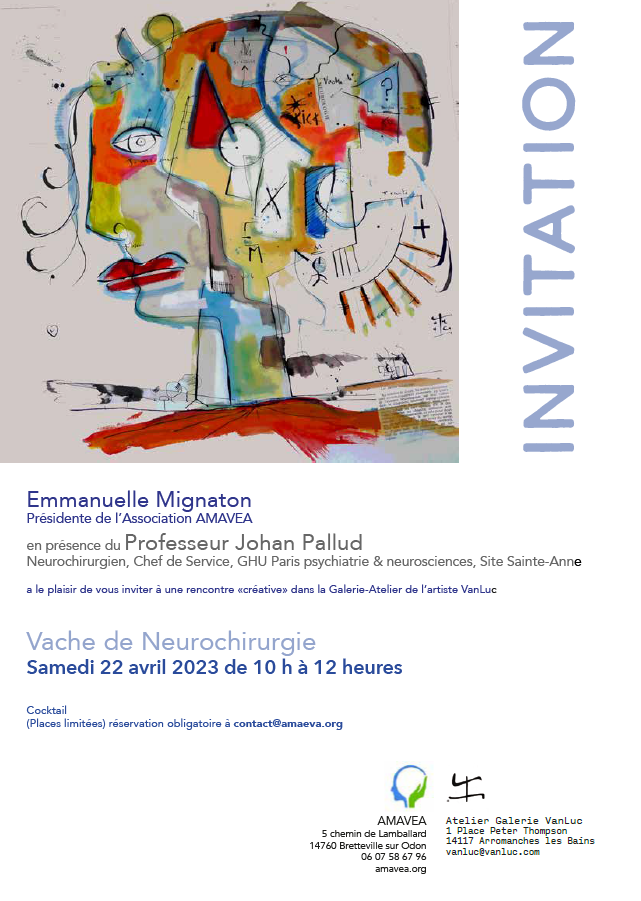
Mais avec les personnes avec qui j’ai fondé l’association, on est prêtes à répondre aux questions et à faire partager nos connaissances et notre expérience. C’est à ça que sert une association de patients, je pense !
Note du 20 mai 2020 : Je précisais dans ce texte il y a un an, ne pas être une lanceuse d’alerte, et pourtant j’ai été invitée par Daniel Ibanez en novembre 2019 au Salon des livres et de l’alerte. J’ai toujours dit à Daniel Ibanez que je n’étais pas une lanceuse d’alerte au sens où moi je l’entendais, et que j’avais simplement fait ce qu’il me semblait être mon devoir de citoyenne à cet instant T. Il m’a dit que c’était exactement ce qu’il recherchait. J’ y suis donc allée. Compte-rendu ici
Find other articles from Amavea here