Lotényl and Lotéran, drugs for gynecological disorders, are to be used with caution due to the risk of benign brain tumors
The medication agency has issued new recommendations in particular concerning these drugs.
Article reserved for subscribers
Faced with the increased risk of meningioma - a cerebral tumor that is most often benign - linked to the use of certain progestins, the National Medicines Safety Agency (ANSM) issued new recommendations on Tuesday, January 12.
Two epidemiological studies by Epi-phare, a joint structure of the ANSM (French National Agency for Medicines and Health Products Safety) and the French National Health Insurance, presented in June 2020, confirmed a significant increase in the risk of meningioma in women taking Lutényl (nomegestrol acetate) and Lutéran (chlormadinone acetate), or their generic equivalents, which are progesterone derivatives. These widely used macroprogestins are prescribed to treat various gynecological disorders: fibroids, endometriosis, irregular cycles, perimenopause, and, less frequently, as contraceptives. While they block ovulation, they are not contraceptive pills.
"More than 1,000 operated meningiomas are attributable to these two molecules between 2007 and 2018, or around 100 cases per year" Alain Weill
The risk of meningioma for women who took these products between six months and ten years is tripled compared to unexposed women. "The risk increases sharply with the cumulative dose, the duration of treatment, and the patient's age," the study specifies. It is even multiplied by 12.5 after five years of treatment with Lutényl, and by 7 after three and a half years with Lutéran. This study involved 1.8 million women who took nomegestrol acetate and 1.5 million who took chlormadinone acetate between January 1,2007 , and December 31, 2018. In total, "more than 1,000 surgically treated meningiomas are attributable to these two molecules between 2007 and 2018, or about 100 cases per year," explained epidemiologist Alain Weill, deputy director of Epi-phare, who led the study. "It's a question of dose and duration of exposure," he continued.
"Review the risk of risk with your doctor"
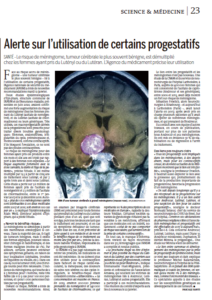
Meningioma develops from the membranes that wrap the brain. In the majority of cases, these are benign tumors, but there are atypical forms, which can require surgery and radiotherapy, and malignant forms (less than 1% of identified meningiomas). In addition, some may cause annoying symptoms, due to their location (headache, balance or visual disorders, etc.). In these cases, or if the tumor grows, heavy surgery may be necessary. The incidence of meningioma, which affects 2 to 3 women for a man, remains very low (from 8 to 9 cases per 100,000 people, and 1 per thousand people treated by these progestins).
Faced with this risk, the ANSM has issued new recommendations, based on the opinion of the expert committee composed of doctors, learned societies and patient associations.
See: The opinion of the expert committee issued on January 12
Therefore, a brain imaging scan (MRI) is recommended for any woman taking Lutényl or Lutéran for more than a year, regardless of age, and then every two years while treatment is continued, and in case of symptoms suggestive of a tumor. "In all cases, it is recommended to consult your doctor and review the risk-benefit ratio of this treatment at least once a year,"explains Dr. Isabelle Yoldjian, head of the gynecology department at the ANSM (French National Agency for Medicines and Health Products Safety).
While the ANSM (French National Agency for Medicines and Health Products Safety) did not deem it necessary to withdraw the products, their indications were restricted: they can no longer be used for contraception (without cardiovascular risk factors), menopause, non-severe breast pain, or irregular cycles, as the benefit-risk ratio is considered "unfavorable." "Consumption is massive in France. In 2019, approximately 200,000 women were taking nomegestrol and 240,000 chlormadinone acetate, representing 80% of prescriptions for these molecules in Europe," notes Dr. Yoldjian. Some learned societies of gynecology did not support these restrictions, asserting that these molecules have advantages, notably "the absence of vascular risk, which occurs when taking certain contraceptives.
Inform as much as possible
In any case, the lack of information is a recurring theme in the 315 testimonies that the ANSM (French National Agency for Medicines and Health Products Safety) compiled and made public, and during the public consultation, available on the ANSM's YouTube channel. For example, this 35-year-old woman was prescribed Lutényl for ten years as a contraceptive. She quickly developed severe migraines and a decreased libido. She never received any information. When she stopped the treatment in 2013, her migraines disappeared. She was suffering from a meningioma. "The choice of contraception or other progestins should be discussed with women," she insists.
“The next step will be to raise awareness as much as possible about the risks of Lutéran and Lutényl, through letters to patients and healthcare professionals, as was done for Androcur,” says Emmanuelle Huet-Mignaton, president and co-founder, with Nathalie Grillot, of the Amavea association, which supports victims of meningiomas linked to Androcur, Lutéran, Lutényl, and other progestins. She participated in drafting these recommendations. A meeting of the expert committee will be held again on January 22. Ms.Huet -Mignaton has also filed a complaint against the Bayer laboratory (Androcur), adding it to the hundred or so filed by lawyer Charles Joseph-Oudin.
The link between progestins and meningiomas is not new. A study by the French National Health Insurance Fund (CNAM) and the neurosurgery department of Lariboisière Hospital in Paris, involving 400,000 women who used cyproterone acetate (Androcur and its generics) between 2006 and 2015, had already shown a significantly increased risk of meningioma, "seven times higher for women treated with a dose of 25 mg/day for more than six months and twenty times higher after five years of treatment with a dose of 50 mg/day." The use of this progesterone derivative has decreased tenfold: 10,000 women are currently treated with Androcur compared to 100,000 in 2016.
In France, it was Sébastien Froelich, then a neurosurgeon in Strasbourg - and today in Lariboisière (Paris) -, who launched the alert in 2007, after taking care of several patients that he had to operate many meningiomas, and who took Androcur.
He led with his team other works, under publication, relating to more than 108 patients on Androcur and 262 meningiomas. They highlighted 91 % stabilization or regression when you stop treatment.
Links not always clear
“All progestins are implicated in meningiomas to varying degrees, but for oral contraceptives, current data from the literature show that the link is very weak,” emphasizes Professor Froelich. It is also important to determine what therapeutic alternatives to these treatments can be offered to patients in whom a meningioma has been discovered.
It would also be necessary to explore the link with pregnancy which, probably due to the significant production of progesterone, promotes the progression of a meningioma, to know what to respond to these women who have a desire for a child.
“We’ve known for a long time that there are progesterone receptors on meningiomas. There’s a proven link for Androcur, Lutényl, and Lutéran, and a suspected link for other progestins,” emphasizes Dr. Romuald Seizeur, head of the neurosurgery department at the Brest University Hospital. At this hospital, “approximately 180 pharmacovigilance reports related to the association between meningiomas and progestins have been filed from 2017 to the present,” he specifies. This concerns Androcur, Lutényl, and Lutéran, but also Diane 35 (low-dose Androcur), Duphaston, the Mirena IUD, and Progestogel… A study on Mirena has just begun.
“The link between the occurrence and development of meningiomas and the use of synthetic progestins exists, but it’s not always so clear,” explains Professor Michel Kalamarides, a neurosurgeon at the Pitié-Salpêtrière Hospital. “ If we performed routine MRIs on all women, we would see that at least 1% have meningiomas, as studies have shown.” This specialist calls for studies on genetic predispositions to the development of these tumors, which will allow for a better understanding of the link between the use of synthetic progestins and the development of meningiomas.