Nouvelle publication dans la revue Neurochirurgie!
Graillon et al. du CHU de la Timone à Marseille viennent de publier leur expérience dans la prise en charge des Méningiomes sous progestatifs de synthèse.
Ils retrouvent une sur-représentation de méningiomes de la base du crâne ainsi que de morphologie transitionnelle.
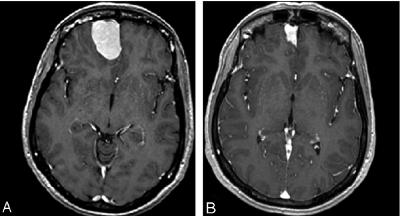
Par ailleurs, ils retrouvent une décroissance du volume des méningiomes plus importante chez les patientes après arrêt de l’Acetate de Cyproterone qu’après arrêt de l’Acetate de Nomegestrol ou de l’Acetate de Chlormadinone.
Objective
The objective of this study was to describe the characteristics and prognosis of meningiomas associated with progestins, as well as their management.
Material and methods
We included 53 patients operated and/or followed in the service for meningioma with a progestogen plug more than one year and with a recent treatment of treatment.
Results
Cyproterone acetate (CPA), Nomestrol (Noma) acetate and chlormadinone acetate (CHLA) were involved in most cases. The average duration of the taking of progestins was 17.5 years.
Tumors were multiple in 66 % of cases and located at the anterior and medial base of the skull in 71 % of cases. The transitional subtype represented 16/25 tumors; 19 Méningiomes were grade I of WHO and 6 of Grade II.
The transitional subtype and location rates of the skull base were significantly higher than in the general population of operated meningiomas. No difference was observed in the WHO custody. But the KI67 proliferation index tended to be lower and 5/6 of the MEMB Méningiomes of the WHO were classified in grade II due to a cerebral invasion.
A strong expression of progesterone receptors has been observed in most cases.
Après l’arrêt du traitement par progestatif, une récupération visuelle spontanée a été observée chez 6/10 patients. Sous CPA (n = 24) et ChlA/NomA (n = 11), le volume tumoral a diminué chez 71 % et 18 % des patients, s’est stabilisé chez 25 % et 64 % des patients et a augmenté chez 4 % et 18 % des patients, respectivement. L’évolution volumétrique était variable en fonction de la localisation tumorale.
Conclusions
Le résultat à l’arrêt des progestatifs est favorable mais différent en comparant CPA versus ChlA-NomA et de la localisation tumorale. Un suivi à long terme est nécessaire.
In most cases, surveillance is recommended and surgery can be avoided.
Lien vers l’étude ici : https://www.sciencedirect.com/science/article/abs/pii/S0028377021001454?via%3Dihub#!
Keywords
Find our other articles here