
Victims of an antipilosity medication continue the Bayer laboratory
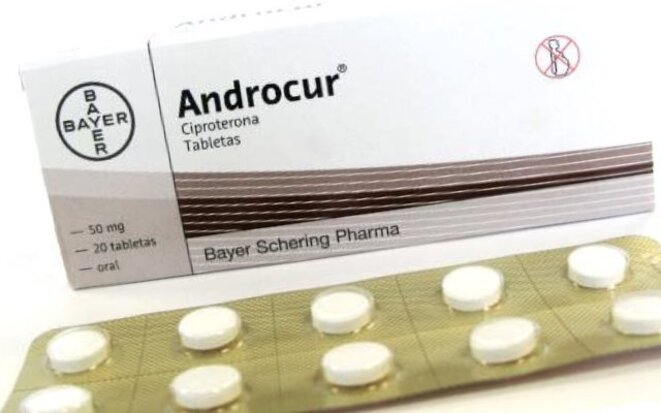
Androcur, treatment intended to reduce hair, has been diverted to be prescribed in the event of acne and as a contraceptive, while it causes brain tumors. At least 500 cases have been identified in France in ten years. According to our information, for the first time, three victims have filed a legal action against Bayer, the manufacturer of this drug taken by 89,000 French women.
This is a first: three victims of Hormonal androcur treatment attack the German giant Bayer, also a happy owner of Monsanto. They assign this manufacturer of an antipilosity drug before the Bobigny tribunal de grande instance for lack of information on the risks incurred: the appearance of brain tumors called meningiomas. This Tuesday, the hearing was set for May 29.
"It is not only public money that should be used to compensate. The laboratory must pay," justifies Emmanuelle Huet-Mignaton, president of the Association for Meningiomas due to Cyproterone Acetate, Assistance to Victims and Consideration of Other Molecules (Amavea), which has been driving the legal action since its creation on January 26.
 © DR
© DRThe doctors she consulted for her endometriosis —a disease that makes periods extremely painful—prescribed this pill, which, when taken continuously, stops the bleeding. Moreover, 15% of Androcur boxes are sold for "contraception," according to the French National Authority for Health (HAS). Even worse, 30% of prescriptions are related to acne, according to the French National Health Insurance. And only 15%—half as many—are for excessive hair growth.
This is the only reason for the three for which Androcur is authorized to be marketed since 1980 in France. The drug is therefore massively diverted from its primary use, to the point that 89,000 French people took it in 2017, according to the latest official figures.
Emmanuelle Huet-Mignaton swallowed from 2003 to September 2017, when her five tumors were identified at MRI. One clearly distinguishes one of them, a white spot as large as an orange.
As soon as her medical file is complete, she will join the complaint. Because since she fully found the use of speech in April 2018, she defends the collateral victims of this treatment.
90% of meningiomas are benign, admittedly. "It's not cancer," Agnès Buzyn, Minister of Health, had clumsily summarized on September 13, 2018 on CNews, "it's not a health scandal"[1].
Health insurance, however, officially attributed the appearance of brain tumors to this cyproterone acetate drug in at least 500 women just in a decade, from 2006 to 2015. While it has been sold for 39 years in France.
The fact that the growing brain tumor puts pressure on the nerves. And there lies the real danger. Because it alters the essential functions of the body. But to remove the tumor is a risky operation. In any case, many patients with meningioma have become epileptics, have lost their capacity for speech, memory, balance, suffer from tinnitus, headache ...
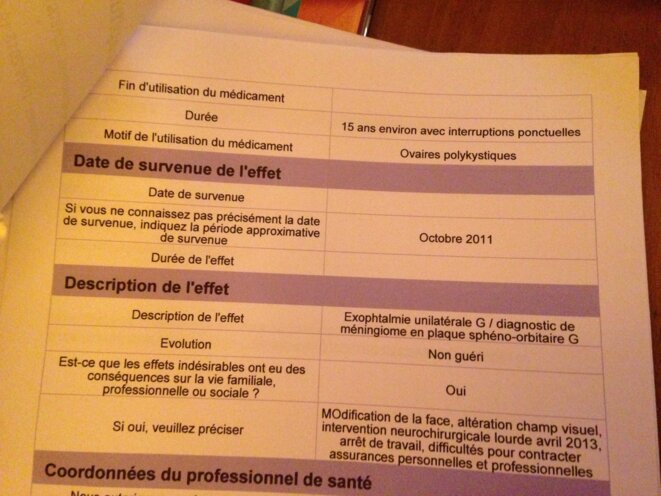
Nina[2], a dental surgeon, nearly lost her sight. During the interview, it was impossible not to notice a lump nestled behind her left eye, as if she had hit it hard. Except it was a tumor. The operation couldn't remove it completely, as it had spread so far around the optic nerve.
Upon discovering the extent of the damage on the MRI, Nina's radiologist's first question was: "Are you taking Androcur?" She had been taking it from 2003 to 2011. Until Bayer added a few lines to the leaflet, lost in a usual stream of contraindications, regarding this risk of meningioma[3], at the request of the European Medicines Agency.
This follows the publication in 2008[4] of suspected links between Androcur and the development of brain tumors by the team of neurosurgeon Sébastien Froelich at Lariboisière Hospital in Paris. This leads Charles Joseph-Oudin, the lawyer for the three victims suing the drug's original manufacturer, to state that "Bayer knew about the risks of Androcur at least since 2008."
This is why he is suing the pharmaceutical company in civil court for failure to provide information about the risks involved and "defectiveness ." This is exactly what he did against Servier when the Mediator scandal broke (even then, doctors had misused the antidiabetic drug, prescribing it as an appetite suppressant without reassessing the crucial benefit/risk balance, thus causing between 500 and 1,500 deaths); and then, more recently, against MSD. Bayer simply stated that it "does not comment on current or future legal proceedings.
The National Medicines Safety Agency (ANSM) and the National Office for Compensation for Medical Accidents (ONIAM) are also assigned, the lawyer says.
 Nina pharmacovigilance declaration. © DR
Nina hesitates to join the sixty patients who already have an Androcur file in the Dante law firm. Eight years after her brain operation, she sees perfectly but she struggles to obtain loans to enlarge her cabinet and insurance refuses to cover her for her tumor: in the event of a recurrence, her house will also be on sale.
Androcur is mainly presented as a magic pill in case of excessive hair or acne
The marketing authorization (MA) for the drug is clear. It stipulates that this tablet is prescribed to men in cases of prostate cancer or "chemical castration" for sexual offenders, and to women forhirsutism .
This seemingly barbaric word actually means "the appearance of hair growth in areas typically considered masculine, which are normally hairless in women (face, chest, back, buttocks, front of thighs, etc.)". This hair growth , "composed of thick, coarse hairs," corresponds to the highest scores on the diagnostic test.
This has nothing to do with a light down, a few hairs under the chin, or hairy arms. Especially since the marketing authorization for Androcur clearly states that prescriptions should only be for "cases of severe hirsutism, when they have a serious impact on the patient's psycho-emotional and social life." And the stylish Nina, with her short, salt-and-pepper haircut, is anything but a "bearded lady.On online forums, Androcur is primarily presented as a magic pill for excessive hair growth or acne. These benefits explain its popularity among women withpolycystic ovaries and the associated hormonal imbalances, like Nina. Gynecologists are, in fact, the primary prescribers of Androcur or its generic equivalents, in nearly six out of ten cases.
Especially since the treatment is covered by insurance! "If only for the sake of healthcare cost savings, the national health insurance system should take stock when the number of prescriptions is so excessive compared to its primary function," the dentist believes. "Any woman is tempted to take a miracle pill that gives her beautiful skin and less hair… Especially when she's unaware of the dangers."
“Cyproterone acetate works very well for acne, but it’s a nuclear bomb,” declares Alain Weill, head of the public health research department at the National Health Insurance Fund, who supported Irène Frachon, the whistleblower in the Mediator scandal. He took a closer look at the data starting in 2016 and teamed up with researchers from Lariboisière Hospital who had raised the alarm eight years earlier.
Together, they carried out a major study carried out on 250,000 women exposed to cyproterone acetate for seven years. In August 2018, the shock results were partly revealed: this high -dose molecule exposes to a risk of meningioma multiplied by seven! And even twenty in the event of prolonged treatment beyond five years[5].
Since then, pharmacists have sold almost half as much of Androcur boxes or its generics, according to our information. But there is still room. France is the first consumer in Europe. France represents 60 % of Androcur sales or its generics in the five countries (France, therefore, but also Great Britain, Italy, Germany and Spain) where they are available in pharmacies.
France is also the first victim: it is affected by 80 % of cases of meningomes linked to cyproterone acetate, according to the ANSM documents.
How can we explain these massive prescriptions in France, outside the established guidelines? The pill was also given there until April 2018 to transgender people, and even at the maximum dose of 100 mg, thus increasing the risks[6]… By reducing male hormones, it erases masculine characteristics, as its name suggests: Andro, from the Greek “man”; cure, from the Latin “care”.
In addition, this is not the first time that gynecologists, first prescribers, have been implicated. They have already been for their massive ordinances of so -called third generation pills, at the end of 2012. And in particular Diane 35, also produced by Bayer.
Diane 35 was initially withdrawn from the market; since August 2013, it has returned to pharmacy shelves, solely as an acne treatment. Androcur contains the same molecule as Diane 35, cyproterone acetate, "but at extremely high doses," explains Ms.Joseph -Oudin. Twenty-five times higher.
In reality, the health scandal surrounding third-generation birth control pills and the ongoing Androcur scandal are linked. Five percent of women suffer frompolycystic ovary syndrome (PCOS) , and 10% struggle with endometriosis.If, in addition, these patients are at risk of cardiovascular problems, gynecologists no longer prescribe third-generation pills to alleviate their symptoms. Too risky.
They therefore turn to Androcur or other lower-dose progesterone derivatives. If gynecologists are so uncomfortable with the subject, it's because alternative remedies are still lacking. "For endometriosis, the only current drug treatment consists of suppressing menstruation, particularly with progestins," explains Horace Roman, a gynecologist specializing in the field.
Better inform doctors of dangers against pharmaceutical lobbying
This "therapeutic impasse" also explains why the health authorities do not remove this hormonal medication from the market, despite its risks.
Stéphanie's tumor was the size of a clementine. A nurse by profession, she blames Bayer, which "did not sufficiently inform gynecologists like mine about the dangers, the one who prescribed Androcur for my polycystic ovaries "The German pharmaceutical company, which refuses to disclose to Mediapart its revenue from this drug, is the primary beneficiary of this over-prescription[7].
“The medical representatives I see parading through the hospital are salespeople; they don’t emphasize the side effects to sell their products!”observes the woman in her forties. “Bayer isn’t going to organize a ‘meningiomas and Androcur’ conference,” quips Geoffroy Robin, a gynecologist at the Lille University Hospital, commissioned by the French National College of Gynecologists and Obstetricians (CNGOF) to answer our questions.
This college is one of these learned companies led by the largest stars in each field and in whom specialists have fully confidence. They also had to alert to the dangers. Their role as prescribers of prescriptions makes it a privileged target of lobbying of the pharmaceutical industry.
However, the German giant directly finances this club of the most renowned gynecologists. "Bayer is a long-standing partner of the CNGOF, with support ranging from 30,000 to 40,000 euros per year," admits the pharmaceutical company.
On December 6, 2018, during the annual CNGOF conference, the first warnings about Androcur were relayed. Geoffroy Robin was the one tasked with delivering them, even though he wasn't even able to implement them all. He admitted that he couldn't contact all the women prescribed Androcur in his department "due to a lack of computerized records"...
In a letter sent in October, the drug agency specifically asked healthcare professionals to contact their patients currently undergoing treatment in order to "reassess the need to continue it"[8]. It also advised against its use in cases of moderate hirsutism and acne.
In December 2018, the ANSM (French National Agency for Medicines and Health Products Safety) also promised "the rapid implementation of an annual treatment agreement form," which still does not exist, but is now expected to be available in early May, according to our information. This will be an informational statement that doctors and patients will have to sign, mentioning this undesirable side effect, for each prescription of Androcur, so that everyone thinks twice before prescribing it.
Another letter is expected to be sent to healthcare professionals by the end of June. The drug regulatory agency will recommend an MRI scan before starting treatment to check for the absence of a meningioma. If it is nourished by the doses administered by the treatment, it grows, and grows.
A reminder of patients, identified thanks to health insurance data, is also provided. This is the same, extremely rare procedure, initiated in the case of the Mediator and the Expakine antiepileptic. A letter should then be sent by the end of June to the women treated in the last 24 months.
And what about the others? The drug agency believes that, since "in many cases, meningiomas linked to taking cyproterone acetate can regress when treatment is stopped," it simply recommends "that women treated in the past discuss it with their doctor," without "performing brain imaging in the absence of clinical signs." It reminds the public of the availability of a toll-free number[9].
For those taking Androcur or one of its generic equivalents, it recommends an MRI "no later than five years after" the start of treatment. Amavea would have preferred more frequent monitoring based on clinical signs, given the rapid development of some tumors.
Emilie's tumor was already the size of a mandarin after only a month of Androcur. Even if it is impossible to know if she was already present in her brain before.
In any case, she was barely 9 years old. The endocrinologist – a hormone expert – had prescribed it for "early puberty," with the aim of "delaying the onset of menstruation." As a result, "after the operation, I became a baby again; I could no longer speak or walk,"confides the now 18-year-old girl, who has developed epilepsy.
As incredible as it may seem, the drug agency also had to recall that this treatment was not recommended in children.
***
[1] The Minister of Health was also questioned by MP Michèle de Vaucouleurs (Democratic Movement and affiliated members), who had herself been alerted by the victims. But her question to the government remained unanswered at the time of publication.
[2] Her first name has been changed, this dentist fearing that her patients will recognize her and doubt her visual acuity.
[3] “Cases of (multiple) meningiomas have been reported in the event of prolonged use (several years) of Androcur in doses of 25 mg per day and more. »»
[4] Froelich S. et al., “ Does cyproterone acetate promote multiple meningiomas? », Endocrine Abstracts. Proceedings of the 10th European Congress of Endocrinology, Berlin, 2008.
[5] Out of approximately five years of treatment at 50 mg per day (dose generally prescribed in the event of major hirsutism) or ten years of treatment at 25 mg per day, which corresponds to half cachets.
[6] Gazzeri R. et al., “Growth of a meningioma in a transsexual patient after estrogen-progestin therapy”, The New England Journal of Medicine, 2007.
[7] 39 years after entering the shelves of pharmacies, Androcur still represents a quarter of cyproterone acetate sales, the generics, who arrived from 1996, sharing the rest of the cake.
[8] However, as the Levothyrox crisis—this medication taken by 5% of the French population for thyroid problems—demonstrated, letters and emails from the ANSM (French National Agency for Medicines and Health Products Safety) often get lost in the overflowing inboxes of healthcare professionals. The Ministry of Health did commission a report "on improving information for users and healthcare professionals about medication." It is full of constructive proposals, such as appointing a "Mr. or Ms. Medication" whose "role is to communicate in the event of a crisis," but it seems to have been relegated to oblivion.
[9] 0 805 04 01 10
If you have information to share with us, you can contact us at enquete@mediapart.fr. If you wish to send documents via a highly secure platform, you can connect to the website frenchleaks.fr.
- Read more on the Mediapart website
Victims of an antipilosity medication continue the Bayer - Médiapart laboratory
Find other articles from Amavea here