Link to the ANSM website: https://www.ansm.sante.fr/Dossiers/Lutenyl-Luteran/Recommandations-d-utilisation-de-Lutenyl-Luteran-et-leurs-generiques-et-de-suivi-des-patientes/(offset)/1
Following the working group "Méningiomes et Progestififies" in which the president of the association Emmanuelle Huet-Mignaton participated, a statement of decisions was made public on January 12, 2021.
Lotényl/Lotéran and risk of meningioma - context


Since the beginning of 2019, we have been alerting healthcare professionals and women to the risk of meningioma* associated with the use of nomegestrol acetate (Lutényl and generics) and chlormadinone acetate (Lutéran and generics) when their use is prolonged and at high doses.
Although this risk is rare at the collective scale (less than one case for 1,000 people treated each year), it increases sharply with the cumulative dose and the age of the patient.
In June 2020, a large-scale epidemiological study[1] made it possible to quantify this risk for the first time:
- A woman who takes one of these treatments for more than six months has approximately 3.3 times more risk of developing meningioma* compared to the basic risk;
- The risk increases with the duration of treatment, and also with the dose used and the age of the patient:
- Under Lotényl the risk is multiplied by 12.5 from five years of treatment
- Under Luteran, it is multiplied by 7 for 3.5 years of treatment
Given this data, we have set up an expert committee, made up of doctors and associative actors, to conduct a global reflection both on the evolution of the use of these drugs with regard to the risk of meningioma and the needs of women for which these treatments are justified.
To learn more about the findings of the epidemiological study, find our June 2020 communication HERE.
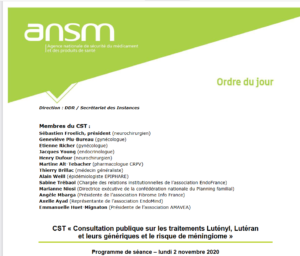
Click HERE to view the page dedicated to the Committee of Experts
*Nomegestrol acetate (Lutényl and generics) and chlormadinone acetate (Lutéran and generics) are progesterone derivatives used particularly in the management of menopause, menstrual disorders and endometriosis.
Study of the EPI-Phare scientific interest group, made up by ANSM and Health Insurance, made from national reimbursement data on 1.8 and 1.5 million women who have consumed nomestrol acetate or chlormadinone acetate between January 1, 2007 and December 31, 201
Given the demonstrated increased risk of meningioma associated with taking nomegestrol acetate (Lutényl and generics) and chlormadinone acetate (Lutéran and generics), our recommendations are as follows:
Situations for which the use of Lotényl/Lotéran can be considered or not with regard to the benefit-risk report, and led to hold
MRI monitoring: implementation conditions
An examination by brain imaging (MRI) should be carried out regardless of the age of the patient:
- at any time during or after treatment in the event of signs evocative of meningiomas;
- after 1 year of treatment when the treatment requires being continued, then 5 years after the first MRI, then every 2 years as long as the treatment is continued;
- to the initiation of treatment in the event of identified risk factors of meningioma (history of encephalic radiotherapy in childhood or neurofibromatosis of type 2).
 |
Download this document (13/01/2021)  (825 KB)
If hormonal treatment is being considered or when the patient desires pregnancy , and in the event of a history of meningioma (operated or not) related to taking nomegestrol acetate, chlormadinone or cyproterone, a multidisciplinary approach must be implemented.
For further information: consult the opinion of the committee of experts (12/01/2021) (50 KB)
Information for patients
| If you are or have been treated by Lotényl (Nomestrol Acetate) or Lutéran (Chlormadinone acetate) or their generics, we invite you to :
|
Questions/answers on the risk of meningioma under Lotényl/Lotéran and their generics
In June 2020, a large epidemiological study made it possible to quantify for the first time the risk of meningioma associated with the use of nomegestrol acetate (Lutényl and generics) and chlormadinone acetate (Lutéran and generics) when their use is prolonged and at high doses:
- A woman who takes one of these treatments for more than six months has approximately 3.3 times more risk of developing meningiom of the basic risk
- The risk increases with the duration of the treatment, the dose used and the age of the patient:
- Under Lotényl the risk is multiplied by 12.5 from five years of treatment
- Under Luteran, it is multiplied by 7 for 3.5 years of treatment
Given this data, we decided to:
- restrict certain indications for these drugs
- Define the conditions for implementing monitoring by brain imaging (MRI)
To view our detailed recommendations, click HERE.
Find our other articles here