Meeting of June 18, 2019 at the ANSM: presentation of two studies, epidemiological and pharmacovigilance, on the Androcur and Meningioma link.
During this meeting, which we were able to attend, two studies were presented: studies conducted on the link between takingAndrocur(Cyproterone Acetate) and the development of meningioma.
These two studies focus on epidemiology and pharmacovigilance. This meeting is part of a monthly technical meeting of the Regional (), a meeting usually closed to non-professionals. This meeting was exceptionally opened to associations and groups, who were able to participate actively, as a question period was offered to them.
Participants:
- Many pharmacists from pharmacovigilance centers
- ANSM representatives
- Representatives of the associations, including Nathalie Grillot for theAmavea association
Presentation of the CNAM study by Mr. Alain Weil
"Prolonged exposure to cyproterone acetate in high doses and risk of meningioma »
A meningioma is a benign tumor in 95% of cases, growing slowly at a rate of 2 to 3 mm per year. The incidence of meningioma in the general population is 8 per 100,000 per year, or 5,000 people in France. Risk factors include age, female sex, and a history of ionizing radiation treatment. Women are at higher risk because the meninges (the membranes surrounding the brain) have progesterone receptors. Receptivity to cyproterone acetate (Androcur) is higher in the second phase of the menstrual cycle, as well as during pregnancy.
Treatment for a tumor that has grown too large often involves surgery (excision, which removes the entire tumor, and decompression when not all of it is removed). However, other treatments exist if surgery is not possible, such as radiosurgery or radiotherapy.
The size and location of the tumor are important factors in determining treatment.
Scientific literature (9 studies on this topic from 2007 to 2016) has shown that people taking
cyproterone acetate often develop multiple meningiomas. When cyproterone acetate is discontinued
, the meningiomas regress or stop growing.
Considering the tumor's volume is more important than focusing on its diameter.
Methodology
This is an "exposed/non-exposed" cohort study conducted using the French National Health Data System (SNDS – formerly known as SNIIRAM). It compares the frequency of occurrence of treated meningioma (event of interest) in women aged 7 to 70 years exposed to high-dose Cyproterone Acetate (defined as at least 3 boxes, i.e., 3 grams, during the first 6 months) and in those who were very lightly exposed (1 or 2 boxes during the first six months).
The primary study (the "incident" cohort in terms of exposure) included women who started taking cyproterone acetate (50 mg or 100 mg tablets) between 2007 and 2014, with follow-up until the end of 2015. A complementary analysis (the "prevalent" cohort) included women already exposed to cyproterone acetate in 2006 (the earliest year available in the SNDS database), with follow-up until the end of 2015.
The event of interest was defined as the hospitalization for a cerebral meningioma requiring neurosurgery for resection, decompression, or radiotherapy. Comparisons were made using Cox proportional hazards models comparing the incidence of events between the different groups: exposed and very low-exposure for the primary analysis, and exposed, very low-exposure, and discontinuation for the sensitivity analysis.
Results
The introduction of Cyproterone Acetate between January 1, 2007, and December 31, 2014, affected 279,678 women.
Among women already exposed to Cyproterone Acetate in 2006 (the "prevalent" cohort of 131,485 women), we observed 485 cases of meningiomas requiring hospitalization for invasive treatment (neurosurgery, radiotherapy) in those exposed to at least 3 grams after 2006. In this cohort, the incidence rate (absolute risk) reached 133 per 100,000 woman-years. As with the "incident cohort," a strong dose-response relationship was observed.
Of the 516 women exposed to cyproterone acetate and hospitalized for a meningioma, 96.0% underwent neurosurgical tumor resection and 4.0% received radiotherapy.
The mean age at treatment was 48.1 years.
It can be estimated that at least 500 meningiomas requiring surgery or radiotherapy were attributable to prolonged exposure to high-dose cyproterone acetate during the decade from 2006 to 2015. This estimate excludes meningiomas that were monitored medically without invasive procedures.
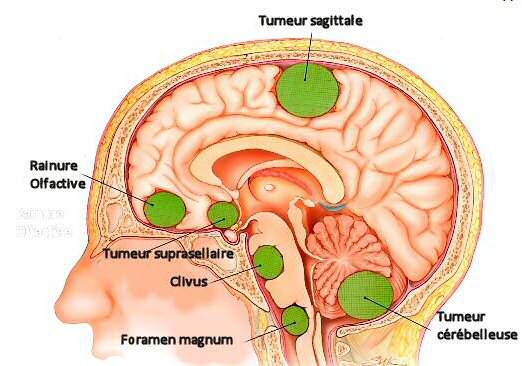
This study also provides precise information on the location of the meningiomas (primarily the anterior and middle skull bases, and generally the medial third of the middle skull base involving the spheno-orbital angle).
Finally, the number of women treated with cyproterone acetate between 2006 and 2014—more than 400,000—confirms, along with the absence in 85% of cases of biological investigations consistent with hirsutism, very widespread off-label use.
Further studies using data from the SNDS (French National Health Data System) are necessary to measure the impact of the interventions carried out, but also the risk associated with other progestins that could be used as a replacement for cyproterone acetate.
The full report of this study is available on the ANSM (French National Agency for Medicines and Health Products Safety) website: Cyproterone acetate (Androcur and its generics) and risk of meningioma: publication of the full pharmacoepidemiological study report – Information point
Pharmacovigilance survey
The pharmacovigilance investigation was presented by the rapporteurs from the Regional Pharmacovigilance Centers (CRPVs). Clinical studies allow for a more in-depth investigation of pharmacovigilance and are therefore a crucial step in understanding the issue.
In 2014, the link between cyproterone acetate (Androcur) and meningioma was not clearly established. The CNAM (National Health Insurance Fund) investigation successfully validated this link. The pharmacovigilance investigations covered the period from January 1, 2014, to October 31, 2018, and were then updated to January 1, 2019, with 298 patients in the study, including 11 men. 151 patients reported having undergone an intervention; the status of the others is unknown. 52% of the data came from patient-reported cases, 70% of which were medically confirmed. The individuals were exposed for approximately 15 years, with cumulative doses of around 219,000 mg.
No risk factors related to family history were noted.
Individuals may have developed up to 20 tumors (41% multiple meningiomas, 55% a single meningioma). The number of tumors is linked to the number of years of exposure and therefore to the increase in cumulative dose.
Caution : there is a significant risk of developing a meningioma during pregnancy. A follow-up MRI should be performed beforehand.
It should be noted that the CRPV survey uses a qualitative approach, with macroscopic data held by the Health Insurance system. Furthermore, CRPV surveys rely on self- reporting, with the inherent limitations (i.e., among other things, the fact that some respondents are unwilling to complete additional questionnaires).
Isabelle Yoldjian intervention (ANSM)
The ANSM (French National Agency for Medicines and Health Products Safety) has been working on this issue since 2016, and the CNAM (French National Health Insurance Fund) study will soon be published in a scientific journal. The epidemiological study could not be conducted before 2016 because there was insufficient data in the databases, which only existed from 2007 onwards. It is not possible to conduct a study on Diane 35 because it is not a reimbursed product, and therefore we do not have the data. In Europe, 60% of anticoagulant prescriptions are issued in France. The history of ANSM alerts was presented: Cyproterone Acetate ( Androcur ) was not withdrawn from the French market due to its usefulness in cases of severe hirsutism (PCOS). Patients do not undergo MRI scans upon discontinuation of treatment if there are no clinical signs, as the risk decreases after stopping the medication. Following the release of informational materials, the ANSM (French National Agency for Medicines and Health Products Safety) believes that the decline in sales (currently at 50%) will be even more pronounced. Information letters about Androcur are being sent to over 80,000 patients and prescribers. July 1st : implementation of the patient/physician agreement for new treatment initiations begins. January 1st , 2020: agreement for ongoing treatments. End of 2019: results of the epidemiological study for other progestins ( Luteran and Lutényl ).
The ANSM (French National Agency for Medicines and Health Products Safety) has published an information bulletin regarding this meeting: Cyproterone acetate (Androcur and its generics) and the risk of meningioma: Results of the pharmacovigilance survey – Information Bulletin.
This bulletin contains the complete pharmacovigilance study.
Find other articles from Amavea here